Lucky Charm Necklace

Difficulty: 2
Technique: brick stitch

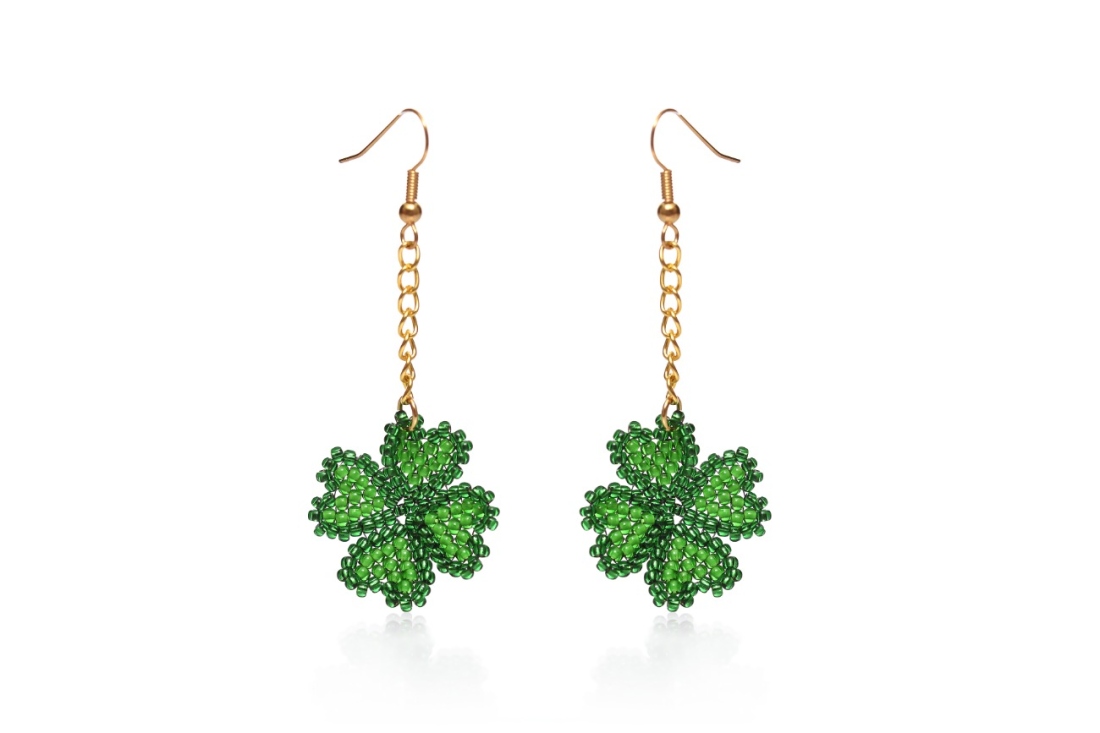
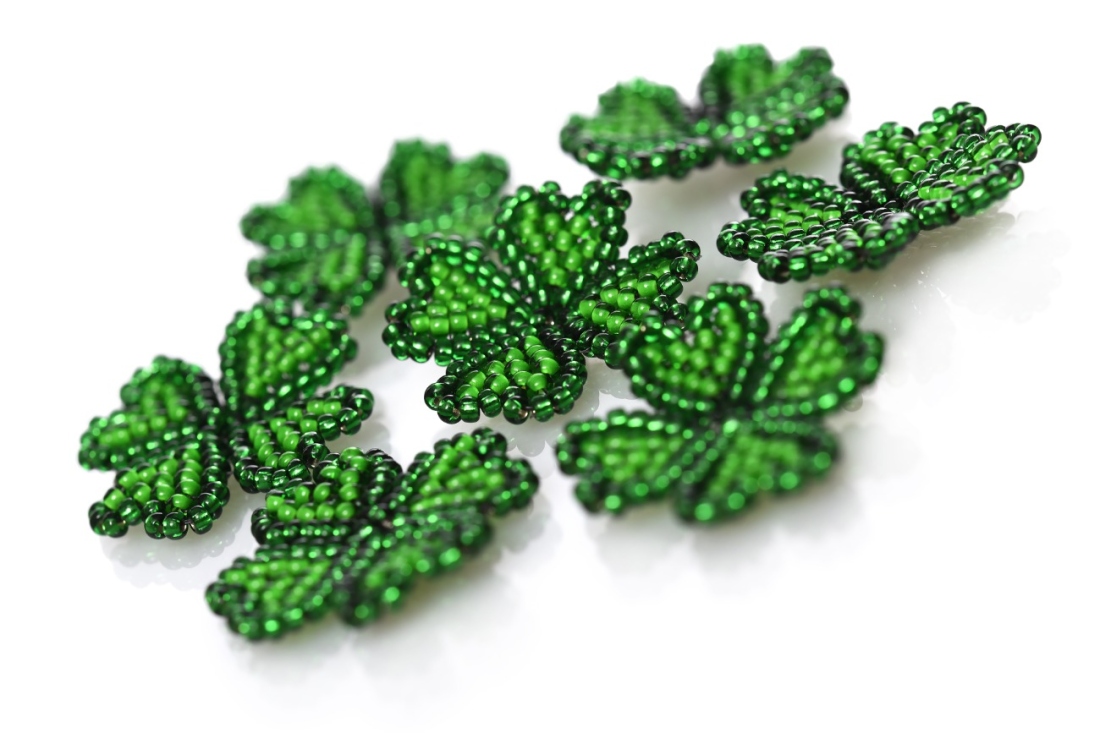
Beaded four-leaf clover made from PRECIOSA seed beads

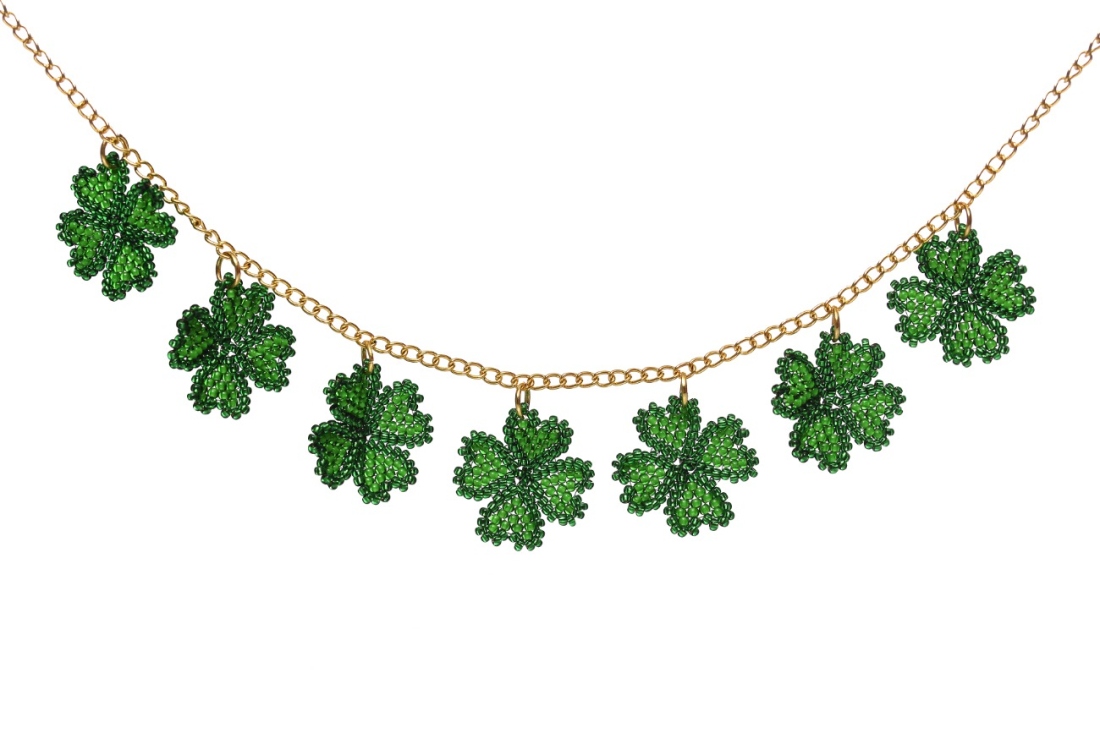
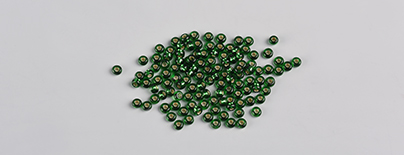
Use PRECIOSA Rocailles to create a handful of vibrant green four-leaf clover motifs. Turn them into a charming necklace to celebrate St. Patrick’s Day or to bring yourself a little luck any day of the year!

Ambassadors

Kerrie Slade

Kerrie Slade have used Czech PRECIOSA Traditional Czech seed beads in her creation.

Learn More

Material and Tools

Tools

Beading thread to match your chosen beads; (Fireline 4lb smoke)
Size 10 to 12 beading needles
Scissors
Gold chain; approximately 45 cm
Jump rings; size 7 mm; gold; 9x
Clasp; gold; 1x
Flat nose pliers; 2x
Wire cutters; 1x

Procedure

Step 1

Size: The finished necklace measures approximately 46 cm but can be made to measure.

Note: In the diagrams, beads with a black outline are the new beads being added, beads with no outline were added in previous steps.

To make the first component:

Thread your needle with 80 cm of thread and pick up 2x R10A. Leaving a 15 cm tail, pass through the first R10A again so that the two rocailles sit side by side. Figure 1.

1

Step 2

Working in brick stitch, pick up 1x R10A and 1x R10B and pass your needle under the thread (known as a thread bridge) on top of the pair of R10A added in step 1 and back through the R10B just added. Complete the row by picking up 1x R10A, passing your needle under the same thread bridge and back through the new R10A. Figure 2.

2

Step 3

Using the same method, work the next row. Pick up 1x R10A and 1x R10B and pass your needle under the last thread bridge created in the previous row and back through the R10B just added. Pick up 1x R10B, pass your needle under the first thread bridge created in the previous row and back through the new R10B. Pick up 1x R10A, pass your needle under the first thread bridge again and back through the new R10A. Figure 3.

3

Step 4

Following figure 4a and 4b work the next 2 rows. Remember that the first 2x rocailles at the beginning of each row are picked up at the same time and the remaining rocailles are added 1 at a time. Add 2x rocailles to the first and last thread bridges in each row and 1x to the other thread bridges.

4 / a

Step 5

To create the top of the first leaf, work a decrease row. Pick up 1x R10A and 1x R10B, skip the final thread bridge created in the previous row and pass your needle under the second to last thread bridge before passing back through the new R10B. Pick up 1x R10A and pass under the next thread bridge and back through the new R10A. Figure 5.

5

Step 6

Pick up 3x R10A and following figure 6, travel to the base of the first leaf.

6

Step 7

Pick up 1x R10A and pass your needle up through the 5x R10A on the other side of the leaf. Work another decrease row of 1x R10A and 1x R10B and then 1x R10A. Figure 7.

7

Step 8

Pick up 3x R10A and follow figure 8 to travel to the base of the leaf. Leave both the working thread and tail thread attached.

8

Step 9

Following steps 1 – 8, make 3 more leaves. Use 45 cm of thread per leaf and leave a 15 cm tail. Figure 9.

9

Step 10

Using the long working thread from the first leaf, follow figure 10 to attach the bottom 3 rows of 2 leaves to each other.

10

Step 11

Using the same method and one of the shorter working threads, attach the next leaf. Figure 11. Tip – hold the spare threads to one side with your non dominant hand.

11

Step 12

Using the same method and 2 of the remaining shorter threads, attach both sides of the final leaf to complete the motif. Figure 12.

12

Step 13

Tie off and trim all threads except the long thread. Ensure that all knots are buried between the R10B in the body of the leaves and not the R10A around the outside edges. Using the long thread, carefully travel around the outside edges of the completed motif. Figure 13.

13

Step 14

Pass through the 4x R10A at the base of the leaves and the first one again. Pull your thread firmly and then tie off and trim the final thread. Figure 14.

14

Step 15

Following steps 1 – 14 make another 6 clover motifs. Figure 15.

15

Step 16

Using the wire cutters, cut a section of chain approximately 45 cm long (or your required length). Using the 2 pairs of flat nose pliers, open a jump ring and pass it through the top of 1 of the clover motifs (between rows 6 and 7) and then through the middle link of the chain before closing the jump ring. Figure 16.

16

Step 17

Using the photo for guidance, decide on the placement of your clovers and attach 3 either side of the central motif using the jump rings. You may wish to vary whether the clovers hang from the left or right side of the leaf tip. Figure 17.

17

Step 18

Attach 1 of the remaining jump rings to one end of the chain and the final jump ring and clasp to the other end. Figure 18.

18 / a

Downloads

This website uses cookies

PRECIOSA ORNELA, a.s. hereby informs you that its website uses cookies You can find more information about our cookies and how your data is processed in the privacy statement. We request your consent to use cookies specified below.

Functional cookies These cookies are necessary for the proper functioning of the website and therefore cannot be turned off.
Analytical cookies Analytical cookies help us track and analyze the way visitors interact with our site using Google Analytics 4. This information allows us to improve content and provide a better user experience. We also use the D&B Visitor Intelligence system as part of our cookies. It helps us more closely identify the individual access to our website.
Marketing cookies Reading and writing cookies used for marketing purposes in advertising systems such as Google Ads or Sklik. These cookies allow us to track user behavior and measure our website performance and the effectiveness of our advertising campaigns.
Personalized advertising Remarketing cookies allow us to present you with personalized advertising based on your previous interactions with our site in systems such as Google Ads, Sklik.
Use of personal data Checking this option means that you consent to your personal data being sent to and processed by Google for the purposes of targeting and evaluating online advertising and targeted marketing.